Sources: Commercial Tobacco Taxation
Data sources for the fact sheet: Commercial Tobacco Taxation
This page provides data and information sources for the coalition's fact sheet titled Commercial Tobacco Taxation: Impacts on Use & Equity
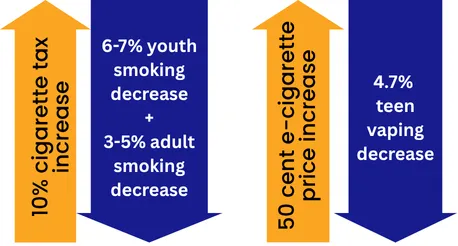
Higher Taxes Reduce Use and Youth Initiation
Sources:
[1] Center for Public Health Systems Science. Pricing Policy: A Tobacco Control Guide. St. Louis: Center for Public Health Systems Science, George Warren Brown School of Social Work at Washington University in St. Louis and the Tobacco Control Legal Consortium; 2014.
[2] Truth Initiative. New Study: Price increases can reduce underage e-cigarette use. April 2023.
Taxing All Tobacco/Nicotine Products at Equivalent Rates
Taxing all tobacco/nicotine products at equivalent rates reduces use
Source: [3] The Importance of Tax Parity for All Tobacco Products. American Cancer Society - Cancer Action Network. The Importance of Increasing Tobacco Taxes at Parity for All Tobacco Products. February 2024.
See also this ACS-CAN fact sheet on Tobacco Excise Tax Increases.
Washington has not historically had equivalence, or parity, for tobacco/nicotine tax rates. For example, the 2019 tax on vapor products taxes the nicotine in e-cigarettes at a 30 times lower rate than the nicotine in a cigarette.
[4] See the tax table below for current tax rates at different levels and forms for each product type. The comparison of the vapor product tax rate to the cigarette tax rate comes from dividing the tax on each type of product by example amounts of nicotine in the product.
- A pack of 20 cigarettes has ~20 mg nicotine and is taxed at $3.025 = 15 cents tax per mg nicotine.
- A Juul e-cigarette pod often contains 35 mg nicotine (0.7 mL 5% nicotine) and under the 2019 law is taxed at 27 cents per mL, which is 19 cents = 0.54 cent tax per mg nicotine.
- A larger Hyde REBEL disposable vape device that contains 500 mg nicotine (10 mL 5% nicotine) is taxed at $2.70 = 0.54 cents per mg nicotine.
Rounding off, the e-cigarette products are taxed at a 30 times lower rate than the cigarettes.
Equity & Commercial Tobacco Taxes
WA receives ~$284 million per year in tobacco taxes in 2025, but none of the revenues are invested into communities to help people quit using nicotine or to address tobacco-related diseases.
Sources: [5] Washington State Department of Revenue. Tax statistics 2025, published October 2025, and past year tax statistic reports.
Cigarette, tobacco and vapor taxes totaled $377,383,000 in FY 2022, $342,466,000 in FY 2023, and $313,322,000 in FY 2024. Commercial tobacco tax revenues have declined steadily for years as fewer people smoke cigarettes and those who do use nicotine can choose e-cigarettes or other nicotine products that are taxed at lower or different rates.
The distribution of commercial tobacco taxes in Washington State is explained on page 2 of the fact sheet, see sources for the Tax Rate Table in the section below.
Excise taxes are more equitable & effective when a significant percentage of the revenue supports commercial tobacco prevention and cessation
”The benefit of increasing cigarette prices would be even larger if the increased tax revenue were earmarked for tobacco control programs and other health programs that serve lower SES population groups, particularly for sustained cessation interventions to reach people who may not quit in response to the price increase or people who are at risk of relapse.” Source: 2024 U.S. Surgeon General's Report
Current WA Tobacco Taxes & History
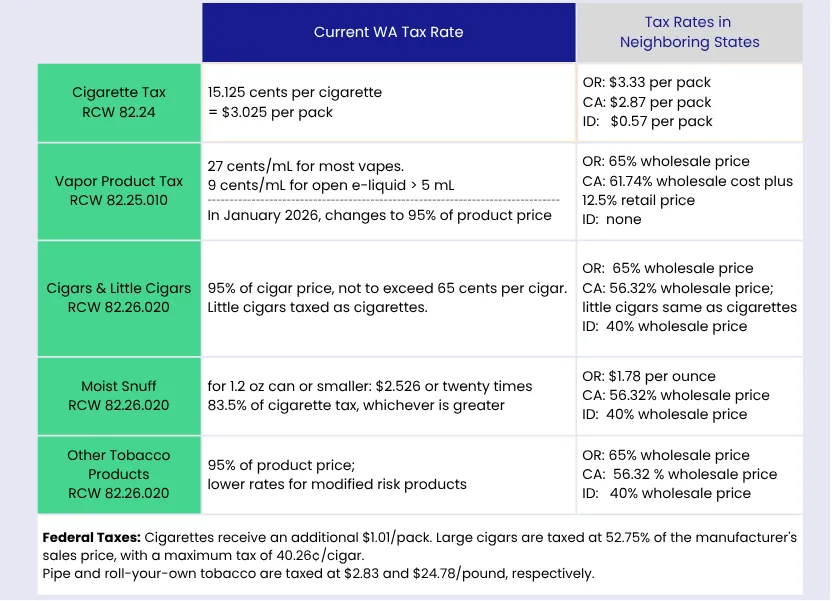
Washington's Commercial Tobacco Tax Rates
Sources:
Tax on Tobacco Products–RCW 82.26
Tax on Vapor Products - RCW 82.25
In January 2026, the tax rate on some nicotine products and on vapor products will be adjusted due to changes enacted by passage of Senate Bill 5814.
For history of these excise taxes and revenue distributions, see the WA Department of Revenue Tax Reference Manuals, 2023.
Comparison to Tax Rates in Neighboring States
Commercial tobacco tax rates in Oregon, California, and Idaho were obtained from the following sources, using tax rates as of November 2025:
American Lung Association: Current State Cigarette Taxes webpage
Centers for Disease Control. STATE system E-Cigarette Tax webpage
Tribal Tax Compacts
Tribes in Washington are sovereign nations with government-to-government relations with WA State.
- 27 of 29 federally-recognized Tribes have formed compacts with Washington State to collect cigarette taxes for sales to non-members on Tribal land.
- Tribal cigarette taxes for non-members must be 100% of the WA cigarette tax, plus state and local sales taxes. A 3-year phase-in is allowed for WA tax increases where the Tribal tax must be at least 80% of the state tax. Tribes may exempt their members from these cigarette taxes.
- The Puyallup Tribe’s compact shares 30% of Tribal cigarette tax revenues with the state.
- Other Tobacco Products and Vapor Products taxes are not included in these compacts.
Sources:
Cigarette tax contracts—Eligible tribes—Tax rate RCW 43.06.460
Cigarette tax agreement with Puyallup Tribe RCW 43.06.465
Cigarette tax agreement—Yakama Nation RCW 43.06.466
Resources
Additional Sources About Commercial Tobacco Taxes & Impacts on Use
Economics for Health: Tax and price webpage